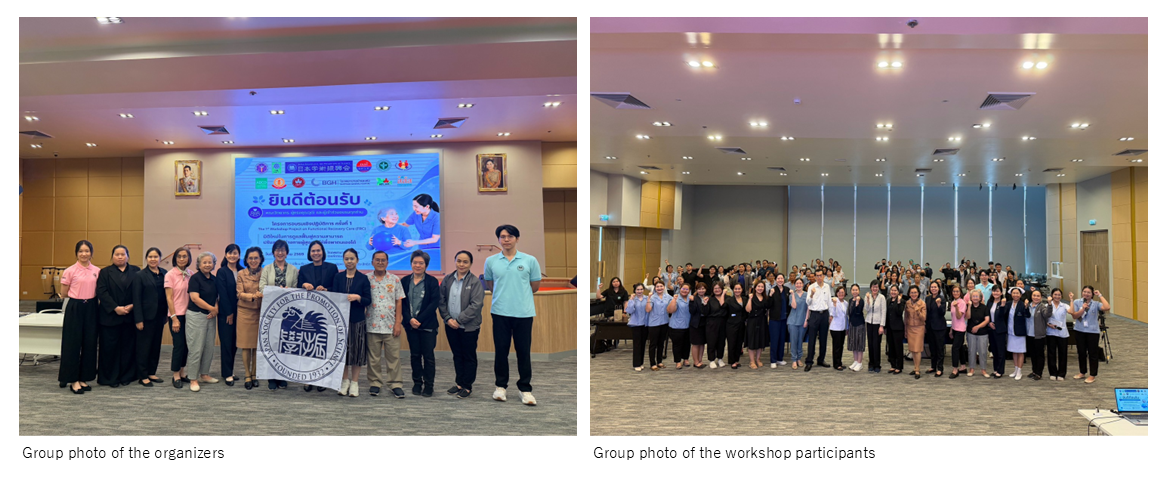







On August 3 and 5, 2026, the National Research Council of Thailand (NRCT), the Japan Society for the Promotion of Science (JSPS), and the JSPS Alumni Association of Thailand (JAAT) jointly organized the 1st Workshop Project on “Functional Recovery Care (FRC)”.
On both days, participants attended lectures introducing the concept and practical applications of Functional Recovery Care (FRC) in Japan, as well as presentations by Thai healthcare and nursing professionals on dementia care and post-stroke rehabilitation practices in Thailand. Through lively discussions and Q&A sessions, participants exchanged views on the current challenges facing elderly care in both countries and shared practical approaches to promoting independent living among older adults. The following report highlights the workshop held on August 5 at Banphaeo General Hospital.
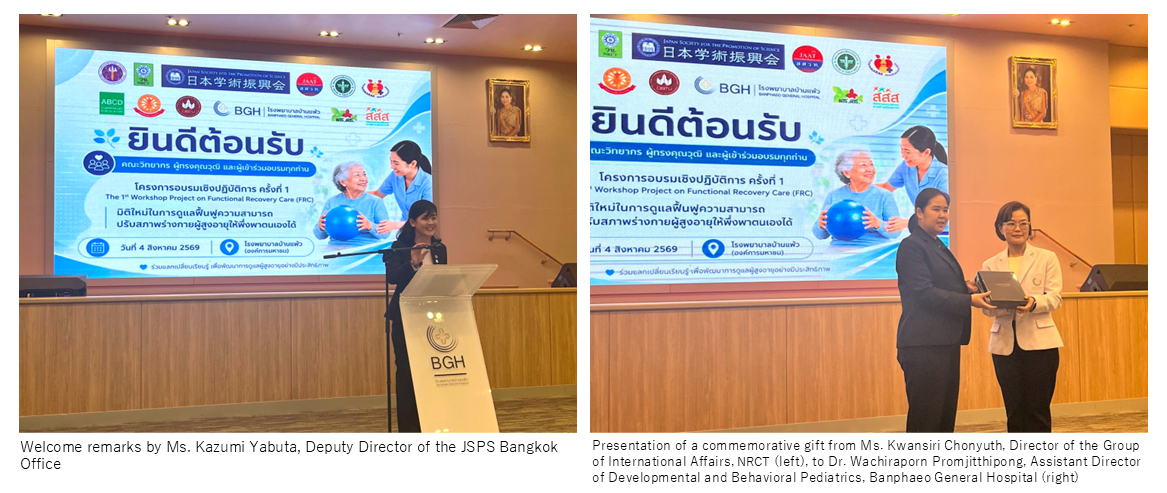
The opening ceremony began with welcome remarks by Dr. Pornpen Pattanasophon, President of JAAT, followed by addresses from Ms. Kwansiri Chonyuth, Director of the Group of International Affairs, NRCT; Ms. Kazumi Yabuta, Deputy Director of the JSPS Bangkok Office; and Dr. Wachiraporn Promjitthipong, Assistant Director of Developmental and Behavioral Pediatrician, Banphaeo General Hospital.
Following the opening ceremony, Assoc. Prof. Dr. Megumi Kodaira, Graduate School of Health and Welfare Sciences, International University of Health and Welfare, delivered a lecture entitled “Functional Recovery Care (FRC): Japanese Specialized Care Method.” Her presentation introduced the principles of FRC and highlighted practical approaches to dementia care and post-stroke rehabilitation in Japan.
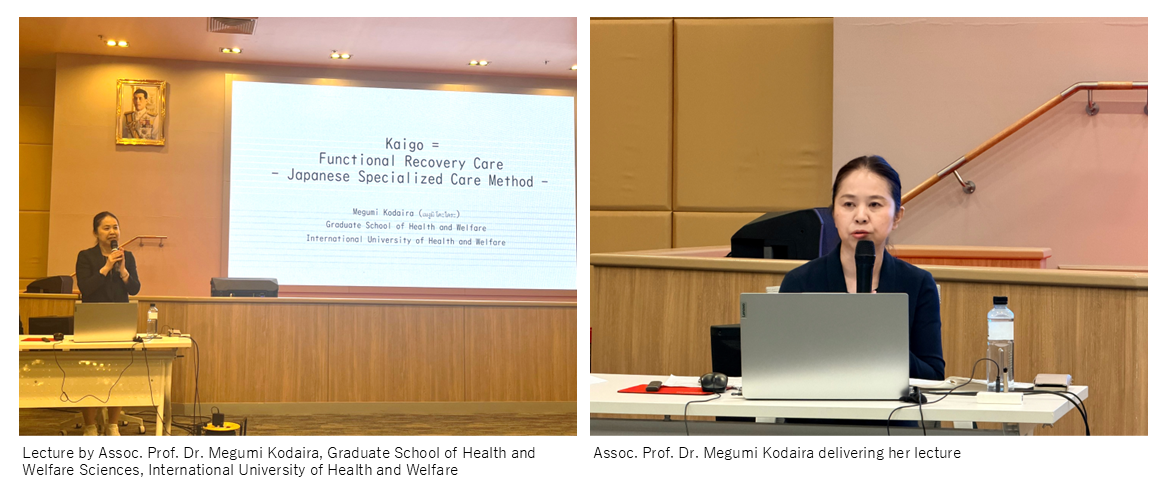
Regarding physical rehabilitation, Dr. Kodaira presented several case studies demonstrating how patients who had been bedridden for extended periods following a stroke regained the ability to walk independently through gradual rehabilitation, beginning with standing exercises and progressing to assisted and independent walking. Additional examples included patients who recovered mobility after months of continuous rehabilitation and those who successfully transitioned from tube feeding to oral intake. These cases illustrated how sustained and appropriate rehabilitation can significantly improve physical function and daily living abilities among older adults.
Regarding dementia care, the lecture emphasized the importance of prioritizing psychosocial approaches that support and enhance patients’ daily functioning rather than relying solely on pharmacological treatment. Dr. Kodaira also highlighted the essential role of adequate hydration, regular physical activity, balanced nutrition, and proper bowel care in maintaining cognitive function and supporting independent living. Through these examples, participants gained a deeper understanding that FRC is a comprehensive care approach aimed not only at restoring physical function but also at respecting the dignity of each older adult and enabling them to maintain an independent life.
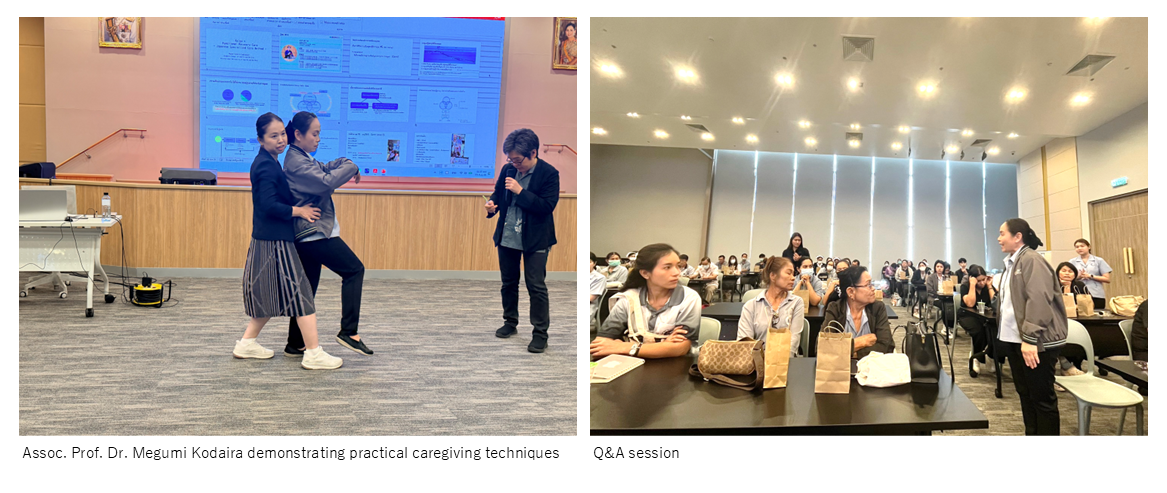
The lecture was followed by an active discussion session. Healthcare professionals from Banphaeo General Hospital raised numerous questions regarding challenges encountered in clinical practice and the implementation of FRC in Japan. Through consecutive interpretation in Japanese and Thai, Dr. Kodaira responded to participants’ questions while demonstrating practical caregiving techniques, further deepening participants’ understanding of FRC.
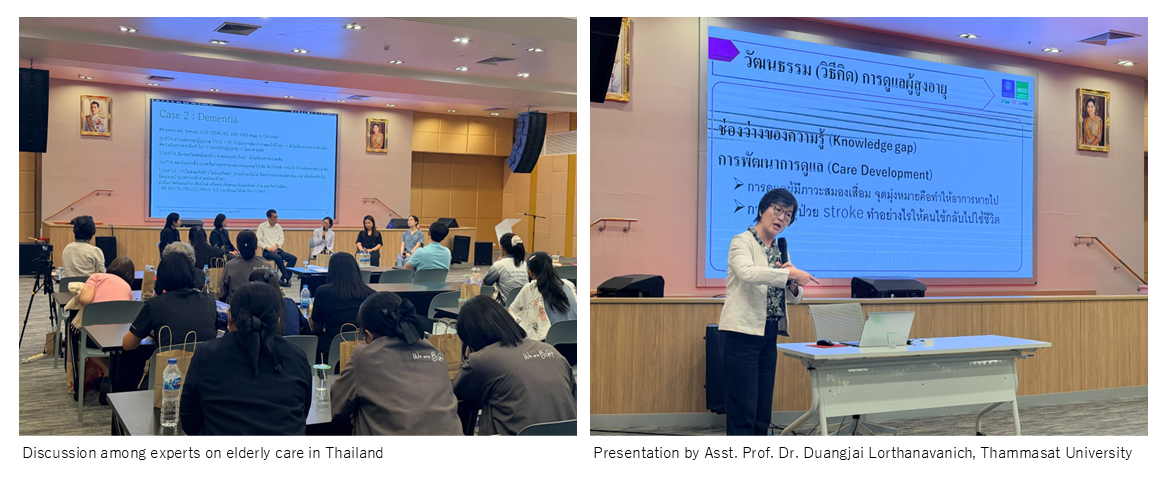
During the afternoon session, healthcare and nursing professionals from Banphaeo General Hospital, Wannarak Hua Hin Co., Ltd., and Thammasat University presented case studies on post-stroke rehabilitation and dementia care in Thailand and discussed current challenges and future directions in elderly care. The session concluded with a presentation by Asst. Prof. Dr. Duangjai Lorthanavanich of Thammasat University, who shared her personal experience of supporting her parents’ functional recovery. Her presentation highlighted the important role of rehabilitation care in promoting independent living among older adults and demonstrated the potential for the wider adoption and further development of Functional Recovery Care.
More than 80 participants attended the workshop. By sharing professional knowledge and practical experience, researchers, healthcare professionals, and caregivers from Japan and Thailand strengthened mutual understanding and expanded their professional networks, contributing to the promotion and further development of Functional Recovery Care for supporting independent living among older adults.